
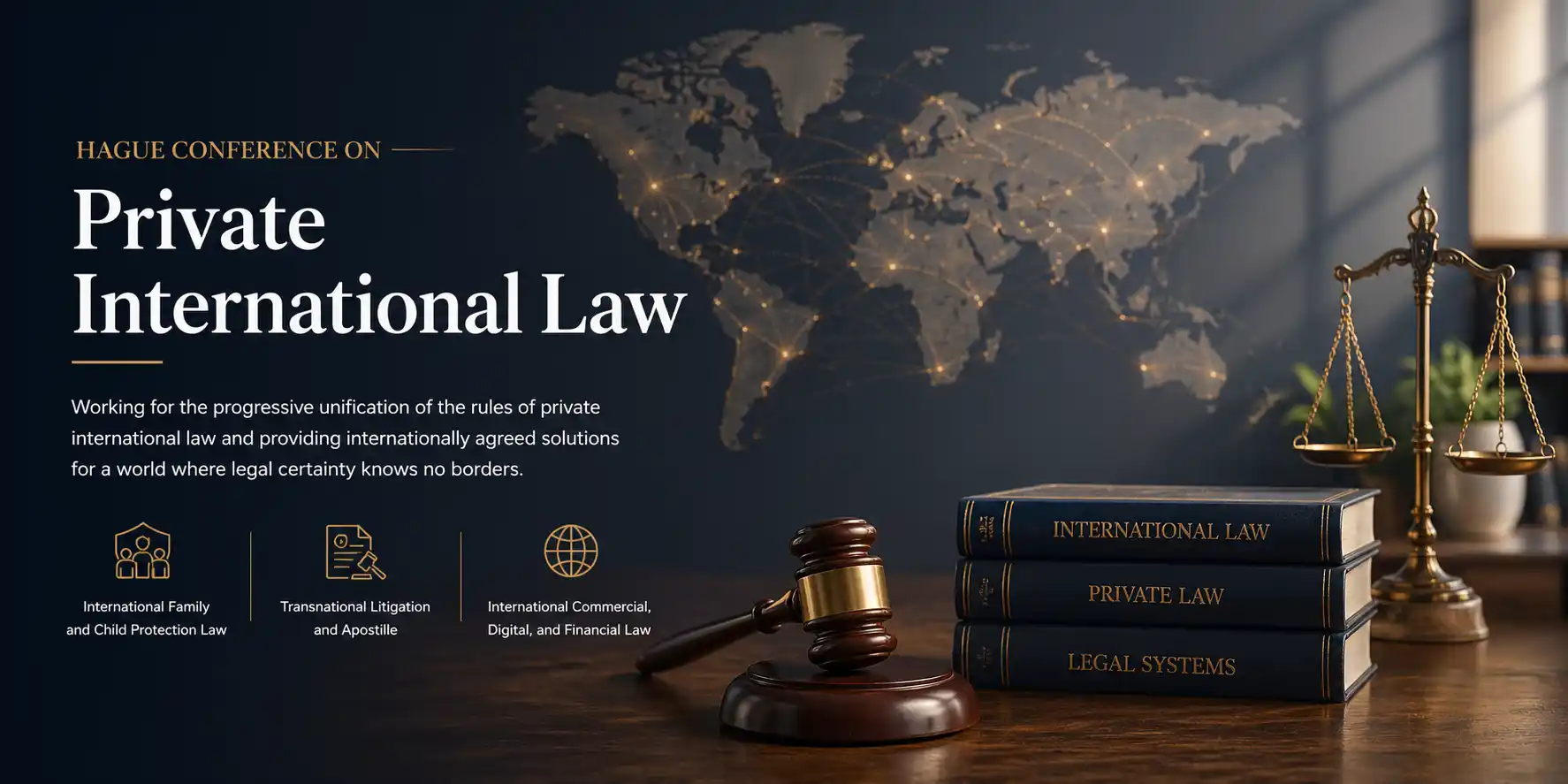
HAGUE CONFERENCE ON PRIVATE INTERNATIONAL LAW
The HCCH (Hague Conference on Private International Law is an intergovernmental organisation whose mandate is “the progressive unification of the rules of private international law” (Art. 1 of the Statute).
In today’s world, individuals and businesses are constantly engaged in cross-border interactions, with work, commerce, study, shopping, travel, relationships and more increasingly taking place across multiple countries. These activities require a high degree of legal certainty and predictability to thrive. However, when taking place across borders the differences between countries’ legal systems often leave gaps in the legal framework, resulting in uncertainty as to which authority has jurisdiction, which law is applicable, how decisions are recognised and enforced and what cooperation mechanisms are available to overcome challenges of cross-border judicial or administrative procedures.
The HCCH’s mission is to resolve these questions by providing internationally agreed solutions, developed through the negotiation, adoption, and operation of international treaties, the HCCH Conventions, to which States may become Contracting Parties, and soft law instruments, which may guide States in developing their own legislative solutions. These Conventions and instruments provide clarity and direction in cross-border relations across three main areas:
- International Family and Child Protection Law
- Transnational Litigation and Apostille
- International Commercial, Digital, and Financial Law
The ultimate goal of the organisation is to work for a world in which, despite the differences between legal systems, persons – individuals as well as companies – can enjoy a high degree of legal security.
MEMBERS & PARTIES
The HCCH currently has 92 Members: 91 States and 1 Regional Economic Integration Organisation. India is also a member of the HCCH.
INSTRUMENTS
Since its inception, over 40 Conventions and instruments have been adopted under the auspices of the HCCH, out of these, a selected number, known as the core Conventions and instruments, are prioritised based on their recent adoption, popularity, or practical relevance.