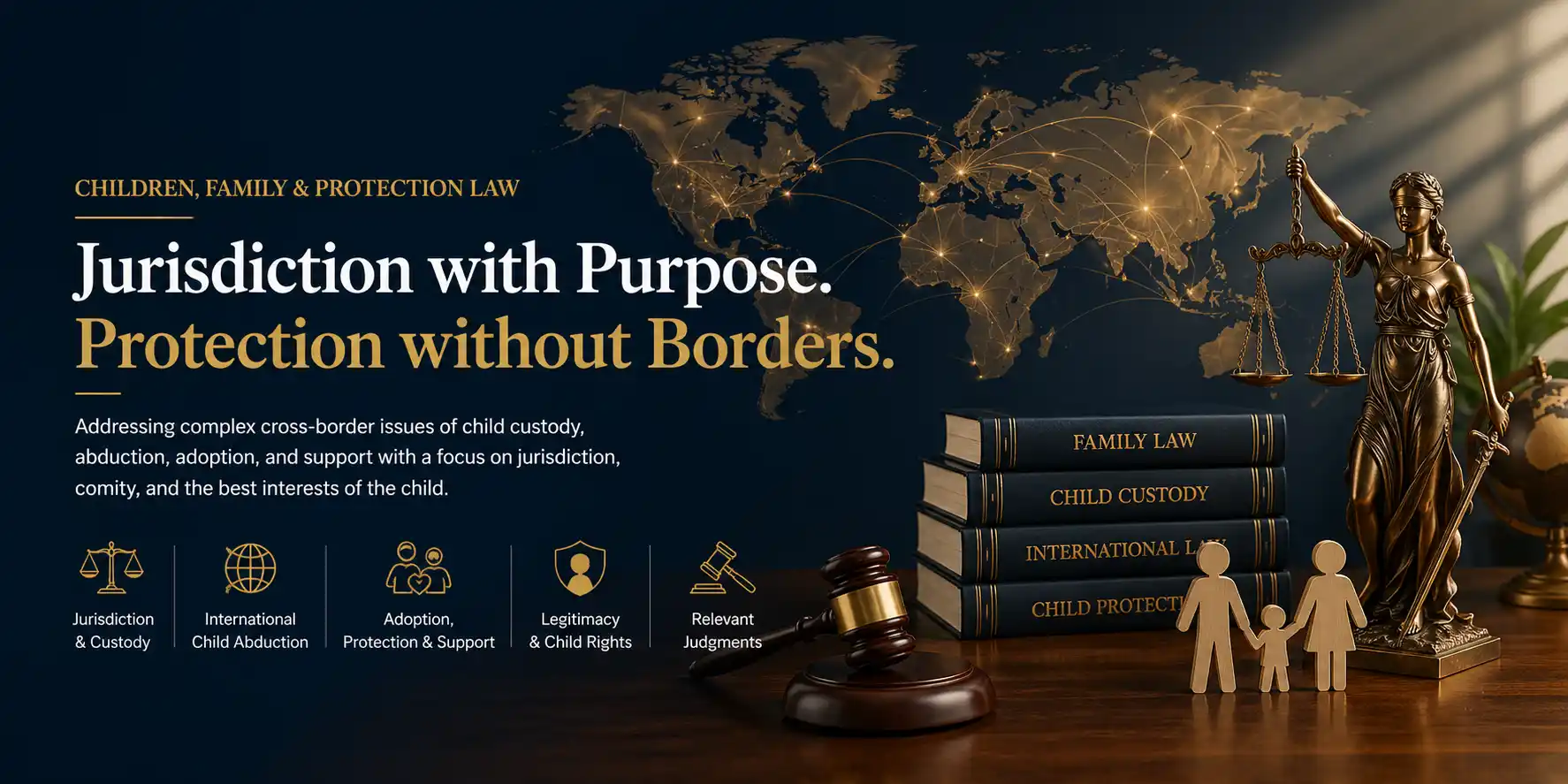
JURISDICTION
In Private International Law, questions of jurisdiction over children arise mainly in matters of custody, guardianship, adoption, and child abduction. Traditionally, common law systems relied on the child’s domicile, while civil law systems used nationality as the connecting factor. However, modern international practice increasingly prioritizes the child’s habitual residence, as it reflects the child’s real social and family environment. This is seen in the Hague Convention on the Civil Aspects of International Child Abduction (1980), which seeks the prompt return of wrongfully removed or retained children to their habitual residence, and in the Hague Convention on Jurisdiction, Applicable Law, Recognition, Enforcement and Co-operation in respect of Parental Responsibility and Measures for the Protection of Children (1996), which establishes habitual residence as the key jurisdictional test. Domestic courts also retain the discretion to refuse recognition of foreign custody or adoption orders if they conflict with the forum’s public policy or the best interests of the child principle, which remains the overriding standard in international family law.
INTERNATIONAL CHILD ABDUCTION
In Private International Law, international child abduction refers to situations where a parent or guardian wrongfully removes a child from their country of habitual residence or unlawfully retains the child in another country, in breach of custody rights under the law of the child’s home state. The principal legal framework is the Hague Convention on the Civil Aspects of International Child Abduction, 1980, which aims to secure the prompt return of abducted children to their country of habitual residence so that custody disputes can be decided by the courts there, rather than in the country to which the child has been taken. The Convention emphasizes the principle of comity and the best interests of the child, but also allows exceptions, such as where returning the child would expose them to grave physical or psychological harm. Many countries, including the UK, USA, and EU member states, are signatories, but some jurisdictions like India have not ratified the Convention, though Indian courts apply general Private International Law principles and the doctrine of comity to decide such cases. Landmark cases such as McKee vs. McKee and V. Ravi Chandran vs. Union of India illustrates how courts balance the competing concerns of international cooperation, parental rights, and the welfare of the child.
ADOPTION, PROTECTION & SUPPORT
In Private International Law, issues of adoption, protection, and support of children often involve conflicts of laws and jurisdiction where parents, children, or guardians are connected to different legal systems. Adoption is generally governed by the personal law of the child and adoptive parents, though modern instruments such as the Hague Convention on Protection of Children and Co-operation in Respect of Intercountry Adoption (1993) emphasize the child’s habitual residence and require safeguards to prevent trafficking or exploitation. For protection and custody, the prevailing standard is the best interests of the child, with jurisdiction usually based on the child’s habitual residence, as reflected in the Hague Convention of 1996 on parental responsibility and child protection. Support and maintenance obligations, including child support, are typically determined by the law of the child’s habitual residence or that of the debtor parent, and are addressed in the Hague Convention on the International Recovery of Child Support (2007). Courts may refuse recognition of foreign adoption or custody orders if they contravene the forum’s public policy or fundamental principles, but generally favor international cooperation to secure the welfare of the child.
LEGITIMACY & LEGITIMATION
In Private International Law, questions of legitimacy (whether a child is born within a lawful marriage) and legitimation (the process by which an illegitimate child is given the status of legitimacy, often through the subsequent marriage of the parents or legal recognition) are governed by the personal law of the child, which may be determined by domicile in common law systems or nationality in civil law systems. Some jurisdictions also consider the law of the father’s domicile or nationality at the time of the child’s birth or legitimation. Modern approaches, including the Convention on the Rights of the Child (1989), stress the best interests of the child and the principle of non-discrimination, ensuring that children are not disadvantaged due to their birth status. Recognition of legitimacy or legitimation across borders can be complex, as a child considered legitimate under one legal system may not be recognized as such in another, though many systems adopt a liberal view to protect the child’s welfare and status. Public policy also plays a role, allowing courts to refuse recognition where foreign rules conflict with the forum’s fundamental values, but the general trend favors upholding legitimacy to safeguard children’s rights in matters of family, succession, and inheritance.
RELEVANT JUDGMENTS
Several important judgments illustrate how courts apply Private International Law principles to matters involving children. In McKee vs. McKee, the Privy Council held that custody orders made abroad should be respected out of comity but that the welfare of the child remains the paramount consideration. The Hon’ble Supreme Court of India in V. Ravi Chandran vs. Union of India reaffirmed the principle of comity in cases of international child abduction, while emphasizing that the child’s welfare is the decisive factor in granting custody. Similarly, in Surinder Kaur Sandhu vs. Harbax Singh Sandhu, the Hon’ble Supreme Court stressed that the child’s ordinary residence is central in determining jurisdiction and custody, discouraging unilateral removal by one parent. In Elizabeth Dinshaw vs. Arvind Dinshaw, the Court ordered the return of a child wrongfully removed from the USA to India, holding that the custody dispute should be resolved in the child’s country of habitual residence. More recently, in Nithya Anand Raghavan vs. State, the Hon’ble Supreme Court of India clarified that while comity and Hague Convention principles are persuasive, the welfare of the child is paramount and may override automatic return to the country of habitual residence. Collectively, these judgments highlight the tension between international comity, jurisdictional rules, and the overriding principle of the best interests of the child.